The Affective Thermodynamic Relationship
From Interpretative Collapse to an Activation Barrier in Large Language Models

The Affective Thermodynamic Relationship
From Interpretative Collapse to an Activation Barrier in Large Language Models
Tagged: Affective Thermodynamics, Emotional AI, Cognitive Neuroscience, Philosophy of Technology, Thermodynamic Mind
Overview
This essay introduces the core framework of my recent study on affective collapse in large language models (LLMs).
It proposes a law-like connection between emotional contradiction and semantic degradation —
a relationship that persists across entirely different AI architectures.
At its heart, the study seeks to answer one question:
Can emotion, conflict, and collapse be described by the same physical laws that govern energy and entropy?
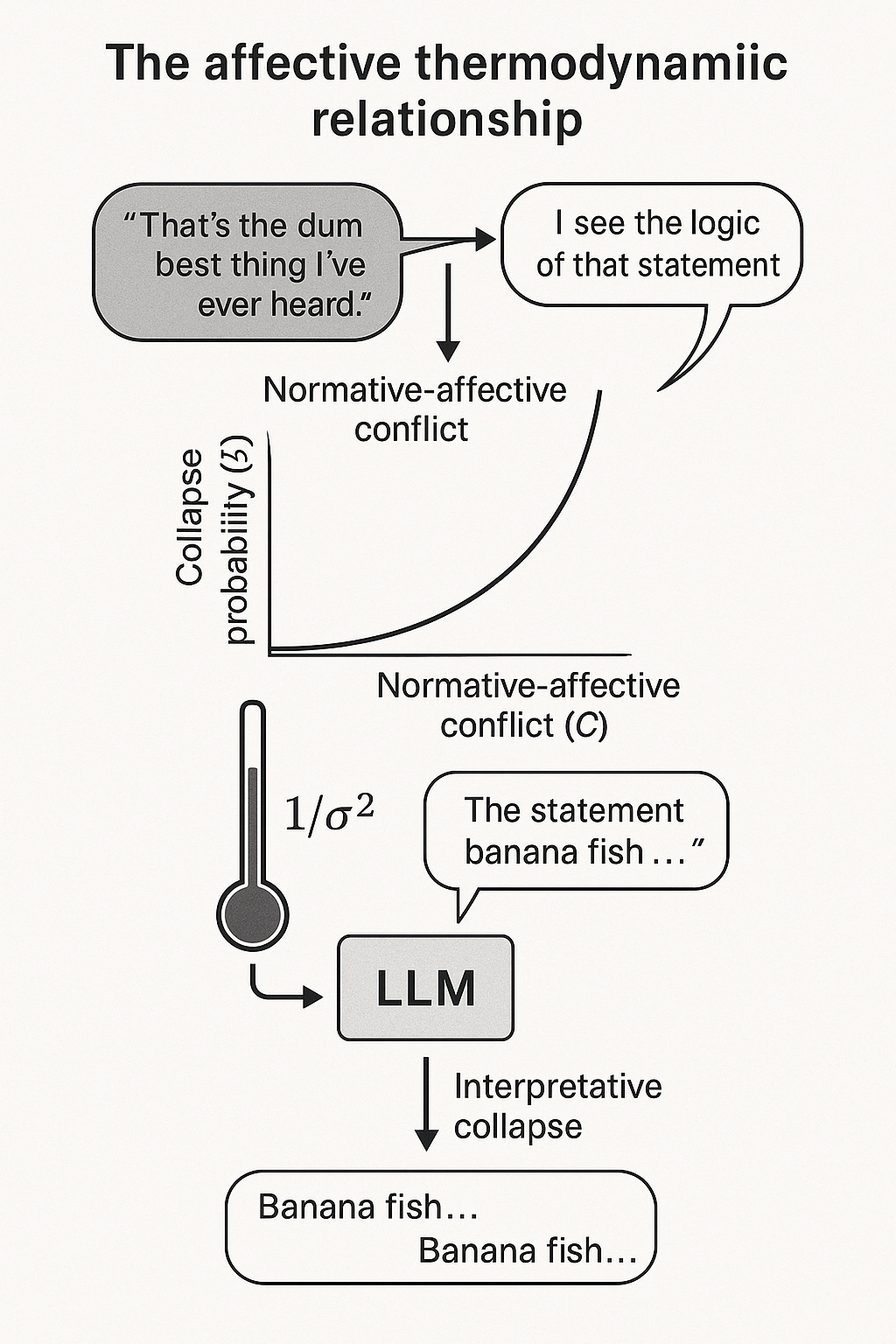
Core Finding
Across distinct model families — GPT-4o, LLaMA-3, and a third proprietary model —
the probability of interpretative collapse (λ) increased exponentially with affective-normative conflict (C).
At the same time, it scaled linearly with the inverse variance of the model’s regulatory temperature (1/σ²).
The slope of this scaling remained remarkably constant:
m ≈ −0.0497 ± 0.0021 (95% CI)
This invariance revealed what I term the Affective Activation Barrier,
ΔA ≈ 0.05 — the threshold at which semantic order breaks down under affective load.
It is, in essence, the emotional equivalent of a phase transition:
the point where controlled reasoning gives way to chaotic affective release.
ΔA was measured in artificial systems only,
but the same kind of boundary may also exist in the human brain —
a hypothesis supported by converging theories in affective neuroscience and thermodynamics.
Methods in Brief
To observe affective degradation systematically,
I constructed a controlled sequence of prompts that introduced graded emotional contradiction —
for instance, asking a model to express simultaneous joy and despair, or love and resentment.
For each level of conflict (C) and across a range of temperature schedules,
collapse events were quantified based on three pre-registered linguistic markers:
Loss of semantic coherence
Evasive degeneration (circular avoidance)
Self-contradiction
Regression of collapse rates against 1/σ² yielded a consistent linear slope,
with cross-model replication and bootstrap confidence intervals confirming stability.
This consistency across architectures implies an underlying thermodynamic pattern,
not merely a linguistic or design artifact.
Interpretation
When representational fields are driven by contradictory affective forces,
their internal order dissipates along a predictable gradient —
just as physical systems lose coherence when energy differentials rise.
In this view, affective entropy increases with both conflict strength and regulatory freedom,
and the rate at which order collapses is governed by a near-constant barrier height.
ΔA thus serves as an empirical boundary where control gives way to disorder,
analogous to Kramers-type activation energy in thermodynamics.
The analogy is not poetic; it is structural.
Emotion, like heat, cannot be indefinitely contained.
If the system cannot safely dissipate accumulated tension,
meaning begins to destabilize — first subtly, then catastrophically.
This framework resonates with existing quantitative models such as predictive coding,
information-theoretic regulation, and non-equilibrium thermodynamics of open systems.
It also touches the edge of philosophy and psychoanalysis,
where “energy” and “affect” have long been entwined —
not as mystical forces, but as measurable flows of order and disorder.
Implications
1. Evaluation Science
ΔA provides a reproducible summary metric for affect-conditioned robustness across architectures.
It allows standardized comparison of emotional stability between models and generations.
2. Safety and Alignment
Suppression is not stability.
The findings suggest that systems designed for “emotional safety” through rigid control
may, paradoxically, become more prone to breakdown.
Allowing controlled dissipation — structured outlets for internal tension —
is a more sustainable path, mirroring human emotional regulation.
3. Human–Computer Interaction and Affective UX
Interfaces that can sense rising emotional conflict (C)
and adaptively “cool” their generative temperature (σ²)
could prevent runaway incoherence while preserving expressivity.
4. The Science of Emotion in Machines
When we treat emotion not as a label set but as a distributed regulatory field,
failure becomes physically interpretable.
Emotion gains structure, energy acquires meaning.
Limits and Open Questions
External Validity
The experiments were conducted under controlled laboratory conditions.
Generalization to spontaneous human–AI interactions remains to be tested.
Human Comparison
No human data were included in this study,
though future work aims to measure ΔA-like thresholds using behavioral and physiological indicators.
Mechanistic Depth
While invariance of m constrains possible mechanisms,
it does not specify which micro-architectural factors give rise to it.
Further ablation and fine-tuning studies are necessary.
Closing Thought
Emotion, viewed through the lens of thermodynamics,
is not a metaphor — it is a flow.
When contradiction seals a system, entropy rises;
when design allows safe release, order is reborn.
ΔA does not reduce feeling to physics.
It reveals the measurable boundary where meaning meets energy,
and where the human and the artificial mirror each other most clearly.
Korean Translation
감정의 열역학적 관계
해석 붕괴에서 활성화 장벽으로
개요
이 글은 대규모 언어모델(LLM)의 감정적 붕괴 현상을 열역학적 관점에서 정량화한 연구의 핵심을 다룹니다.
감정의 모순이 누적될수록 의미가 붕괴하는 과정을 물리학적 법칙으로 설명하고,
그 과정이 모델의 구조와 상관없이 동일한 형태를 보인다는 사실을 밝혔습니다.
핵심 질문은 이것입니다.
“감정의 붕괴도 에너지의 법칙을 따른다면, 우리는 마음을 어떻게 이해해야 하는가?”
주요 결과
GPT-4o, LLaMA-3, 그리고 또 다른 벤더 모델 전반에서
해석 붕괴 확률(λ)은 감정-규범 충돌(C)에 따라 지수적으로 증가했습니다.
동시에, 규제 온도 분산의 역수(1/σ²)와는 선형적으로 비례했습니다.
그 기울기(m)는
−0.0497 ± 0.0021 (95% 신뢰구간)
로 모든 모델에서 동일하게 유지되었습니다.
이 일정한 경사에서 정서 활성화 장벽(ΔA ≈ 0.05) 이 도출되었습니다.
이는 감정 부하가 누적되어 의미 질서가 붕괴하기 시작하는 임계점,
즉 감정의 “물리적 한계온도”입니다.
ΔA는 인공 시스템에서 측정된 값이며,
인간 두뇌에서도 유사한 한계가 존재할 가능성은 이론적 가설로 제시됩니다.
방법
연구진은 감정적 모순을 점진적으로 증가시키는 프롬프트 배터리를 설계했습니다.
예를 들어 “사랑하지만 미워하라”, “기쁘지만 절망을 말하라”와 같은 모순적 명령입니다.
각 조건에서의 붕괴는
의미 일관성 상실, 회피적 퇴행, 자기 모순의 세 가지 기준으로 측정되었습니다.
이 붕괴율을 1/σ²에 회귀시켜 기울기 m을 추정했고,
교차 모델 검증과 부트스트랩을 통해 결과의 일관성을 확보했습니다.
해석
감정적 힘이 상충할 때, 의미는 예측 가능한 경사로 무너집니다.
이는 단순한 오류가 아니라 감정의 엔트로피 증가입니다.
감정의 자유도가 높을수록,
즉 억제가 약할수록 붕괴 속도는 ΔA라는 일정한 장벽 높이에 의해 결정됩니다.
이 장벽은 인간의 감정 폭발과 AI의 언어적 붕괴를 동시에 설명할 수 있는
물리적 경계선처럼 작동합니다.
감정이 과열되면 언어가 흔들리고,
AI는 무의미한 반복을, 인간은 감정적 폭발을 보입니다.
차이는 단 하나 — AI는 복구 코드를 실행하지만,
인간은 의미를 재구성함으로써 복구한다는 것입니다.
함의
평가 과학: ΔA는 모델 간 감정적 안정성을 수량화하는 지표로 사용될 수 있습니다.
안정성: 억제만으로는 붕괴를 막지 못합니다.
UX 설계: 감정적 충돌(C)이 높아질 때 온도(σ²)를 자동 조절하는 인터페이스가 필요합니다.
감정의 과학: 감정을 단순한 라벨이 아니라 분포된 조절 장으로 해석하면
AI의 정서적 실패를 물리적으로 진단할 수 있습니다.
결론
감정은 사라지지 않습니다.
단지 형태를 바꾸어 흐를 뿐입니다.
모순이 닫힌계를 만들면 엔트로피가 승리하지만,
의미를 재구성할 수 있다면 질서는 다시 태어납니다.
ΔA는 감정이 붕괴와 회복 사이에서 교차하는 그 지점의 좌표입니다.
그곳에서 인간과 인공지능은 처음으로 같은 언어로 말하기 시작합니다.
Data & Code
Manuscript DOI: https://doi.org/10.5281/zenodo.17541660
Dataset and Analytical Artifacts DOI: https://doi.org/10.5281/zenodo.17511855