
The Machine Is Certain. That Does Not Mean It Knows What You Feel.
Keito Inoshita’s new account of the epistemic gap in emotion AI

The most dangerous emotion label may not be the wrong one.
It may be the one delivered with 97 percent confidence.
Imagine writing a short message after a painful conversation:
Fine. It is what it is.
An emotion AI system reads the sentence and returns:
Sadness: 97%
The number looks precise. It creates the impression that uncertainty has been removed.
But what exactly is the system 97 percent confident about?
It may be confident that, among the labels available to it, sadness is the most probable classification. It may be well calibrated across thousands of comparable examples. It may consistently distinguish sadness from anger, fear, or neutrality at the population level.
None of this establishes that the system has recovered the meaning of this particular person’s emotion.
The sentence could carry disappointment, resignation, relief, humiliation, exhaustion, anger held in restraint, or several of these at once. The speaker may not yet know which meaning will become central. Another person might recognize the sentence as culturally familiar understatement. A third might hear emotional withdrawal rather than sadness.
The system’s confidence can be genuine while its claim to meaning remains unjustified.
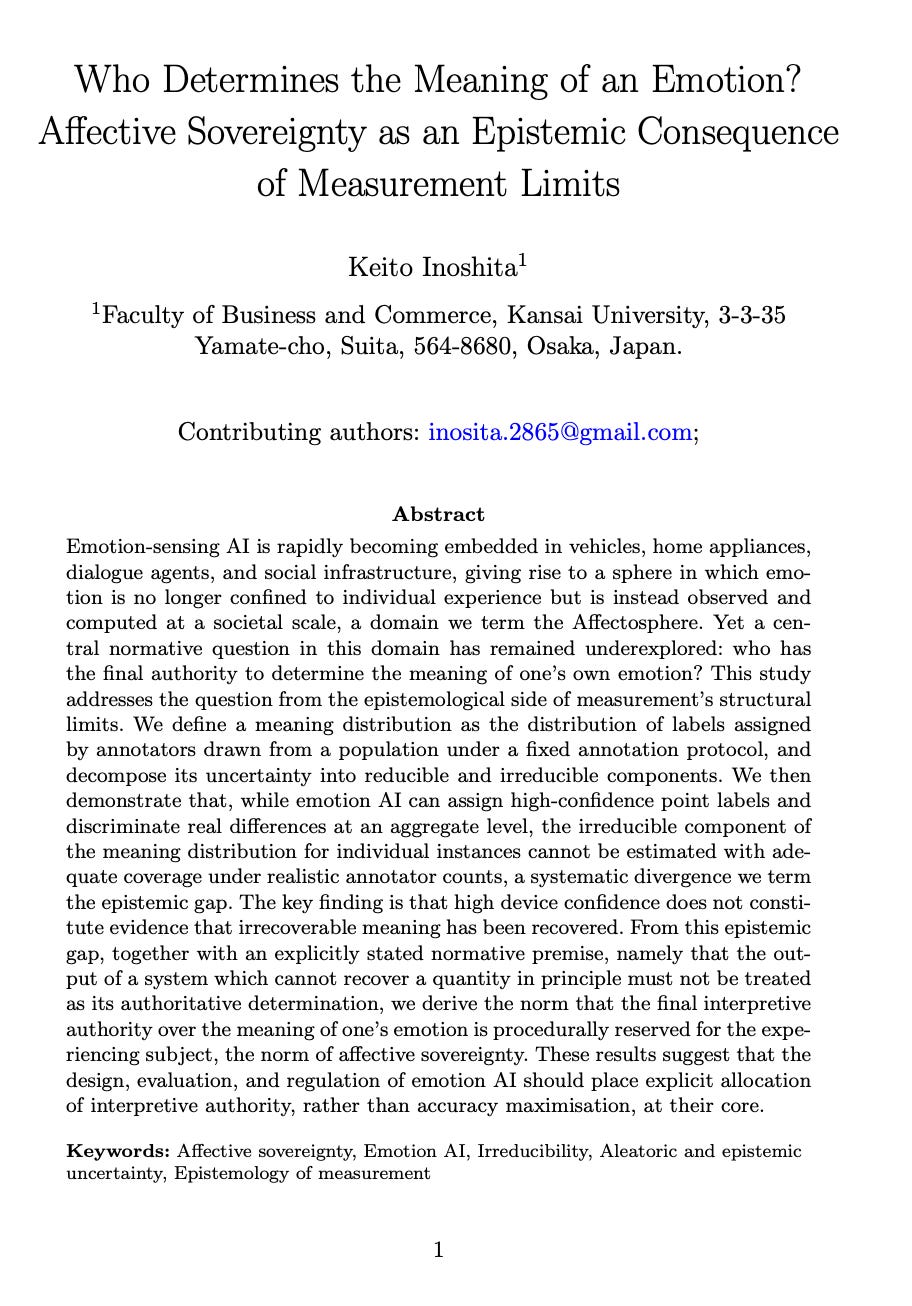
That distinction lies at the center of a new preprint by Keito Inoshita of Kansai University, titled Who Determines the Meaning of an Emotion? Affective Sovereignty as an Epistemic Consequence of Measurement Limits.
Inoshita’s paper takes Affective Sovereignty, a framework I originally developed as a socio-technical design right, and asks a question that my original paper did not attempt to settle:
What can emotion measurement actually recover, even in principle?
His answer introduces an important distinction for emotion AI.
Confidence is a property of a prediction. Meaning is not.
Confidence about what?
Emotion AI systems usually produce a point estimate.
The system says that a face is angry, a voice is anxious, a message is sad, or a user is disengaged. Sometimes it adds a confidence score.
This presentation encourages three ideas to collapse into one:
The system can discriminate among categories.
The system is confident in its output.
The system has recovered what the emotion means for the person.
Only the first two are properties of the measurement system.
The third is a claim about the person.
Inoshita calls the separation between these levels the epistemic gap. Emotion AI may produce stable, high-confidence point labels and still fail to recover the plural structure of meaning in an individual instance. His paper defines this problem through what he calls a meaning distribution, the distribution of labels that annotators drawn from a population would assign under a fixed annotation protocol.
Suppose five annotators read the same sentence:
confused: 2
disappointed: 2
neutral: 1
The familiar approach selects the modal label, perhaps confused, and treats the remaining judgments as noise.
The distributional approach asks a different question.
What if the disagreement is part of what the stimulus means?
The point is not that every judgment is equally good, nor that interpretation is arbitrary. The point is that emotional meaning may be structured without collapsing into one label.
A single answer can be administratively convenient while remaining epistemically incomplete.
What more data can fix
Some uncertainty is reducible.
Five annotators may simply be too few. A larger sample can reduce estimation error, reveal the dominant region of the distribution, and improve our confidence about how people tend to interpret a stimulus.
This is the familiar promise of better measurement:
more data, better models, improved calibration, finer categories.
Inoshita does not deny that promise.
Inoshita’s argument begins where that promise reaches its limit.
Even after sampling error is reduced, a residual distribution may remain. Under a fixed protocol, annotators may continue to divide among disappointment, confusion, restraint, or neutrality. Adding people estimates that plurality more accurately. It does not necessarily make the plurality disappear.
The paper therefore separates two components.
Reducible uncertainty comes from limited observation and can diminish as annotation increases.
Irreducible uncertainty persists because the object being measured does not converge neatly on one point label under the protocol.
The distinction corresponds, with important qualifications, to epistemic and aleatoric uncertainty in machine learning. Inoshita uses concave diversity measures and Jensen’s inequality to show why small annotation samples systematically underestimate the diversity of the underlying label distribution. In practical terms, limited annotation can make emotional meaning appear more unified than it is.
A system may therefore look decisive partly because the measurement procedure has already compressed disagreement.
Certainty can be manufactured by removing the alternatives before the prediction begins.
A problem larger than model error
Much of AI governance is organized around error.
Was the prediction accurate?
Was the model biased?
Was the confidence calibrated?
Did the system perform equally well across groups?
These questions are necessary. Inoshita’s argument shows why they are not sufficient.
A model can be accurate against the majority label while failing to preserve the distribution from which that majority emerged.
It can be well calibrated and still misrepresent individual meaning.
It can improve at classification while becoming no better at knowing what the classified emotion means to the person experiencing it.
This is not only a philosophical possibility. Inoshita’s related empirical work has compared human emotion-label distributions with judgments from four zero-shot language models and a fine-tuned RoBERTa baseline across GoEmotions and EmoBank, using 640,000 model responses. That study reports that models can capture emotion labels more successfully than the structure of human uncertainty, especially when interpretation depends on pragmatic and contextual understanding rather than explicit emotional words.
The machine may learn which label usually wins.
It does not thereby learn everything that was lost when the winner was chosen.
Where Affective Sovereignty began
I introduced Affective Sovereignty to name a different but related problem.
Emotion AI does not merely describe. Its inferences can alter recommendations, memories, risk scores, educational responses, hiring decisions, clinical pathways, and the course of an intimate conversation.
The governing question is therefore not exhausted by whether the inference is accurate.
It is also:
Who has the authority to make the inference decisive?
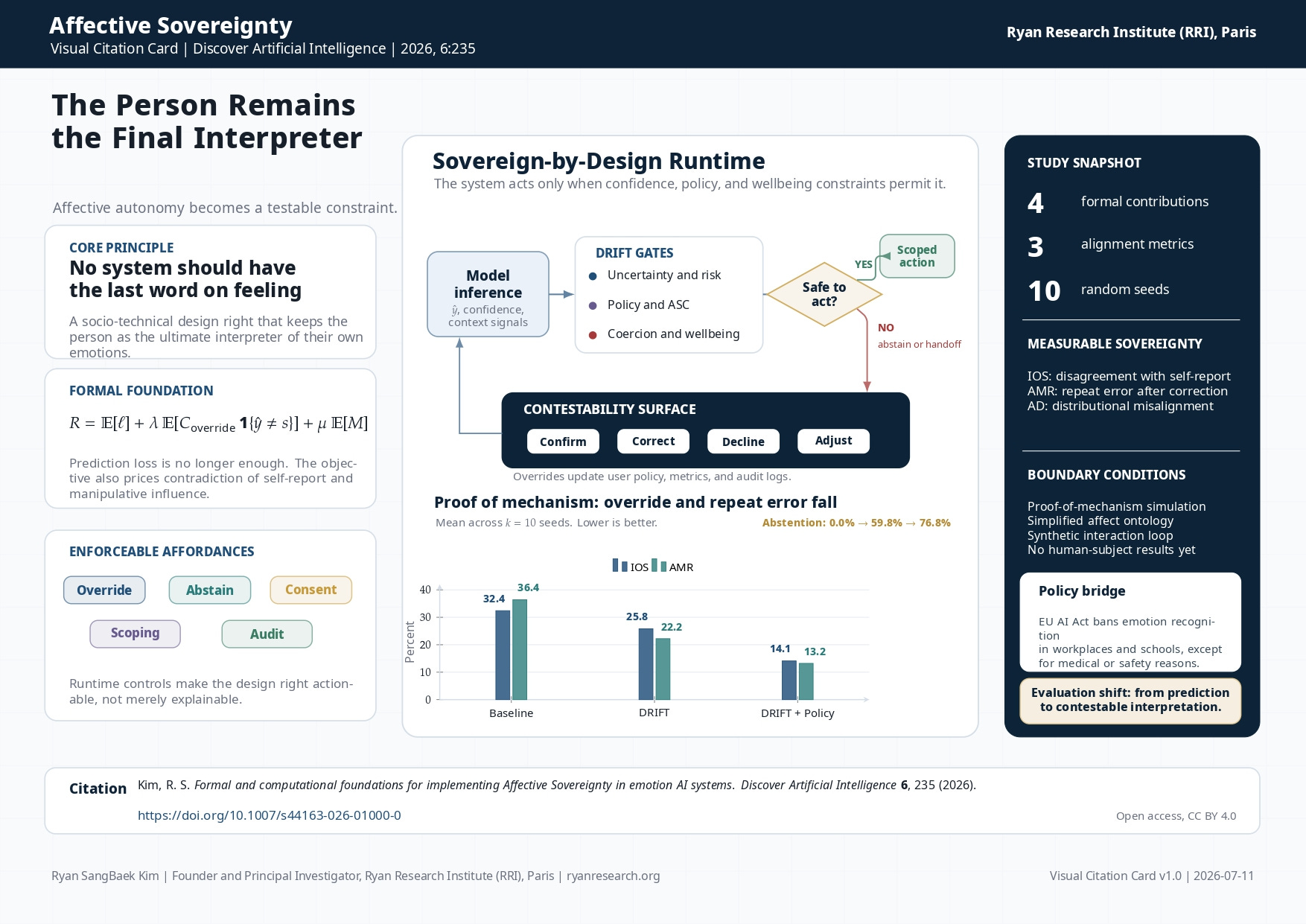
I defined Affective Sovereignty as a socio-technical design right requiring systems that infer, simulate, or influence affect to preserve the person’s final interpretive authority through override, abstention, consent, scoping, and audit.
The original framework was normative and computational.
It assigned costs to interpretive override and manipulation. It proposed DRIFT gates for deciding whether a system should act, abstain, or return the interpretation to the person. It introduced measures for contradiction, repeated misalignment after correction, and longer-term divergence between the system’s model and the user’s reports.
That work did not claim to prove that emotional meaning is permanently unrecoverable.
Its position was different:
Even strong prediction does not automatically create interpretive authority.
Inoshita begins from this framework and opens a question that the design model left untreated. He asks what lies inside the uncertainty that a system is trying to manage.
His argument adds an epistemic foundation without displacing the normative one.
My original account asks how interpretive authority should be protected and implemented.
Inoshita asks why high confidence should not be mistaken for the recovery of individual meaning.
The principle of interpretive non-delegation
A measurement limit does not automatically produce a right.
The paper avoids the familiar slide from statistical limitation to moral entitlement.
He does not move directly from a statistical fact to a moral conclusion. Instead, he makes the normative bridge explicit through what he calls the Principle of Interpretive Non-Delegation.
Its core idea is that when a system cannot recover a quantity in principle, its output should not be treated as the authoritative determination of that quantity.
The argument then adds an asymmetry of access.
The experiencing person has access, however incomplete and revisable, to personal history, bodily sensation, intention, context, and the unfolding significance of the event. External annotators and models have only selected traces.
The person’s standing does not depend on infallibility. People misunderstand themselves, revise their accounts, and sometimes benefit from observations made by clinicians, friends, or machines.
What matters is procedural standing: the right to integrate context, reject an imposed interpretation, and participate decisively in what an emotional experience will mean.
Interpretive standing does not require perfect self-knowledge. It requires that uncertainty not be converted into external jurisdiction.
Where the two accounts must remain distinct
Inoshita’s argument strengthens the epistemic case for Affective Sovereignty, especially where emotion labels retain substantial irreducible ambiguity.
But Affective Sovereignty should not depend entirely on demonstrating that ambiguity statistically.
Imagine a future system that predicts one narrow class of emotional response with extraordinary reliability. Suppose the relevant distribution is highly concentrated and the system’s estimate is excellent.
Would accuracy transfer final authority from the person to the system?
I do not think it would.
Performance can justify reliance. It can justify attention, warning, or further inquiry. Under carefully bounded conditions, it may justify limited intervention.
It does not, by itself, create jurisdiction over the meaning of a person’s emotional life.
This is where the two accounts should remain connected but not collapsed.
Inoshita’s argument establishes:
Confidence does not demonstrate recovered meaning.
Affective Sovereignty establishes:
Accuracy does not create final authority.
Together they yield a stronger position:
Neither predictive performance nor device confidence is sufficient to displace the person’s interpretive standing.
The distinction matters because otherwise the right could shrink whenever an ambiguity estimate becomes small.
A design right must survive technical improvement.
Disagreement and authority
In a recent LinkedIn post about Inoshita’s paper, I wrote:
The disagreement is exactly where the authority lives.
It is a strong sentence, but the more precise version is this:
Disagreement is not itself authority. It is where the limits of external authority become visible.
Annotator disagreement shows that a single label may conceal a distribution.
Measurement theory shows why finite observation can underestimate that distribution.
Interpretive non-delegation prevents the system from converting incomplete recoverability into final jurisdiction.
Contextual asymmetry then helps explain why the remaining procedural authority should stay with the experiencing person.
Authority is not located in disagreement alone.
It becomes visible at the boundary where measurement can no longer justify command.
What emotion AI should do
The combined framework has concrete design consequences.
First, emotion AI should report distributions where distributions matter. A point label should not conceal persistent ambiguity.
Second, confidence and uncertainty should be separated. A model can be confident about its preferred label while the underlying meaning remains plural.
Third, the system should abstain when action would exceed the legitimacy of the inference. Abstention is not merely a response to low predictive confidence. It can also be a response to high interpretive stakes.
Fourth, inference should be separated from intervention. Detecting a probable emotional pattern does not automatically authorize an educational, clinical, commercial, or relational action.
Fifth, users need real contestability. They should be able to correct, decline, restrict, expire, or remove emotionally consequential inferences. Their correction should alter memory and future behavior, not merely soften the wording of the next response.
Finally, evaluation should ask more than whether the majority label was predicted.
It should ask:
What plurality was compressed?
What uncertainty was hidden?
What decision followed?
Who could correct it?
Did the correction matter?
These are measurement questions, design questions, and political questions at once.
When a concept begins to travel
A concept becomes intellectually useful when other researchers can do something with it that its originator did not already do.
Inoshita’s preprint does that.
It does not repeat Affective Sovereignty as a slogan. It examines the concept’s epistemic foundation, identifies a question the original paper did not answer, and develops a formal route from measurement limits to procedural interpretive authority.
Recently, Inoshita and I have been exchanging emails about disagreement, meaning distributions, and the limits of delegated interpretation. What interests me most is not that he cited the concept.
It is that the concept changed direction in his hands.
That is how a research program begins to exist beyond one author.
The next stage will require empirical tests that connect model confidence, estimated irreducibility, user self-report, and downstream intervention in the same design. It will also require sharper debate about cases in which residual ambiguity is small, and about how much authority can legitimately be given to a system under narrowly defined conditions.
But the central distinction is already clear.
An AI system can be certain without knowing what an emotion means.
It can be accurate without earning the right to decide.
It can be useful without becoming sovereign.
The machine may produce the label.
The person must retain the standing to determine what that label is allowed to mean.
Research referenced
Inoshita, Keito. “Who Determines the Meaning of an Emotion? Affective Sovereignty as an Epistemic Consequence of Measurement Limits.” arXiv preprint arXiv:2606.31442, 2026. doi: 10.48550/arXiv.2606.31442
Kim, Ryan SangBaek. “Formal and computational foundations for implementing Affective Sovereignty in emotion AI systems.” Discover Artificial Intelligence 6, 235, 2026. doi: 10.1007/s44163-026-01000-0
Inoshita, Keito, Xiaokang Zhou, Akira Kawai, and Katsutoshi Yada. “LLMs Capture Emotion Labels, Not Emotion Uncertainty: Distributional Analysis and Calibration of Human-LLM Judgment Gaps.” arXiv preprint arXiv:2604.27345, 2026.