Where Emotion AI Actually Breaks
On assumptions, not accuracy

Emotion AI has not failed for lack of data.
It has failed because its assumptions were never made explicit.
Over the past decade, affective computing has steadily improved its benchmarks. Models label emotions more accurately, datasets grow larger, and evaluation pipelines look increasingly polished. Yet these gains coexist with persistent instability: brittle generalization, opaque failure modes, and results that often resist replication.
These are not incidental problems. They are structural.
Most emotion AI systems treat emotions as self-evident objects—things that can be labeled, compared, and optimized without further justification. In practice, this presumes that emotional expression is direct and transparent. It rarely is.
Human emotion is regulated.
It is withheld, softened, exaggerated, redirected, or narratively reframed. Expression is not a raw signal but an outcome of motivational pressures: defense, self-protection, avoidance, and control.
Most datasets ignore this layer entirely.
DefMoN begins from that omission.
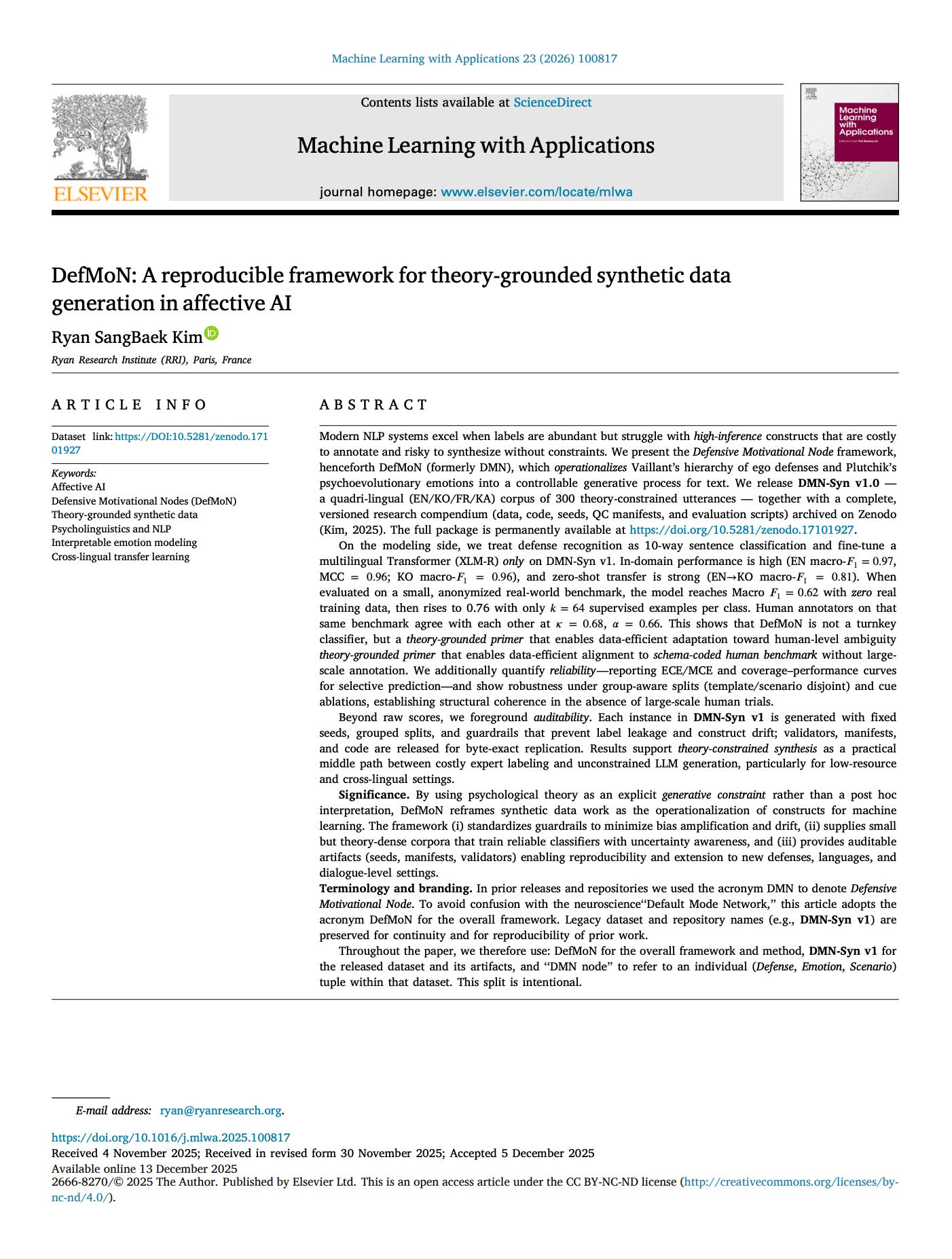
DefMoN—Defensive Motivational Nodes—is not a dataset, nor a generic synthetic data generator. It is a framework for constructing data in which emotional expressions are generated as consequences of underlying motivational structures. The central concern is not volume, but intelligibility: whether the data carries with it a clear account of why it takes the form it does.
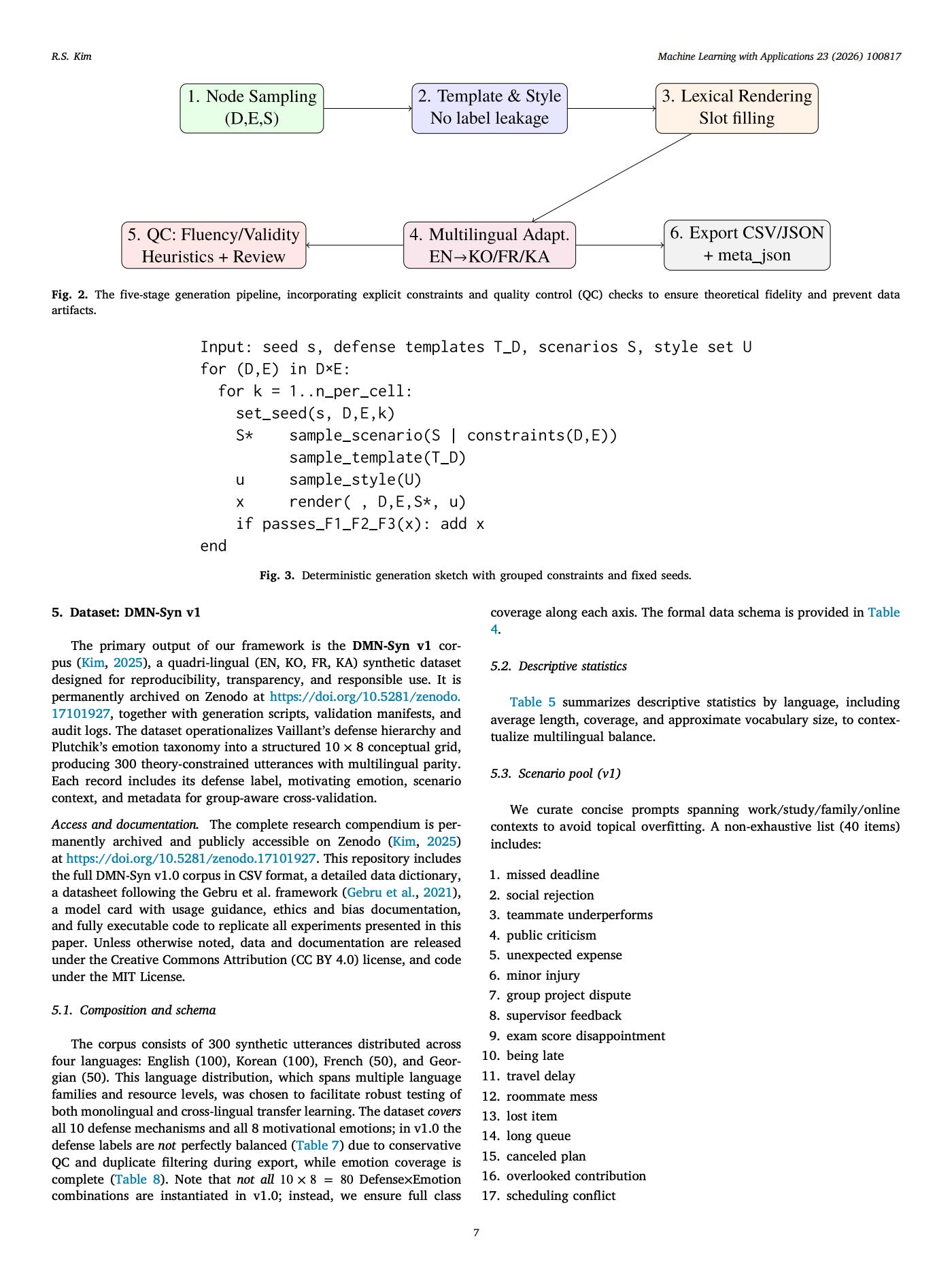
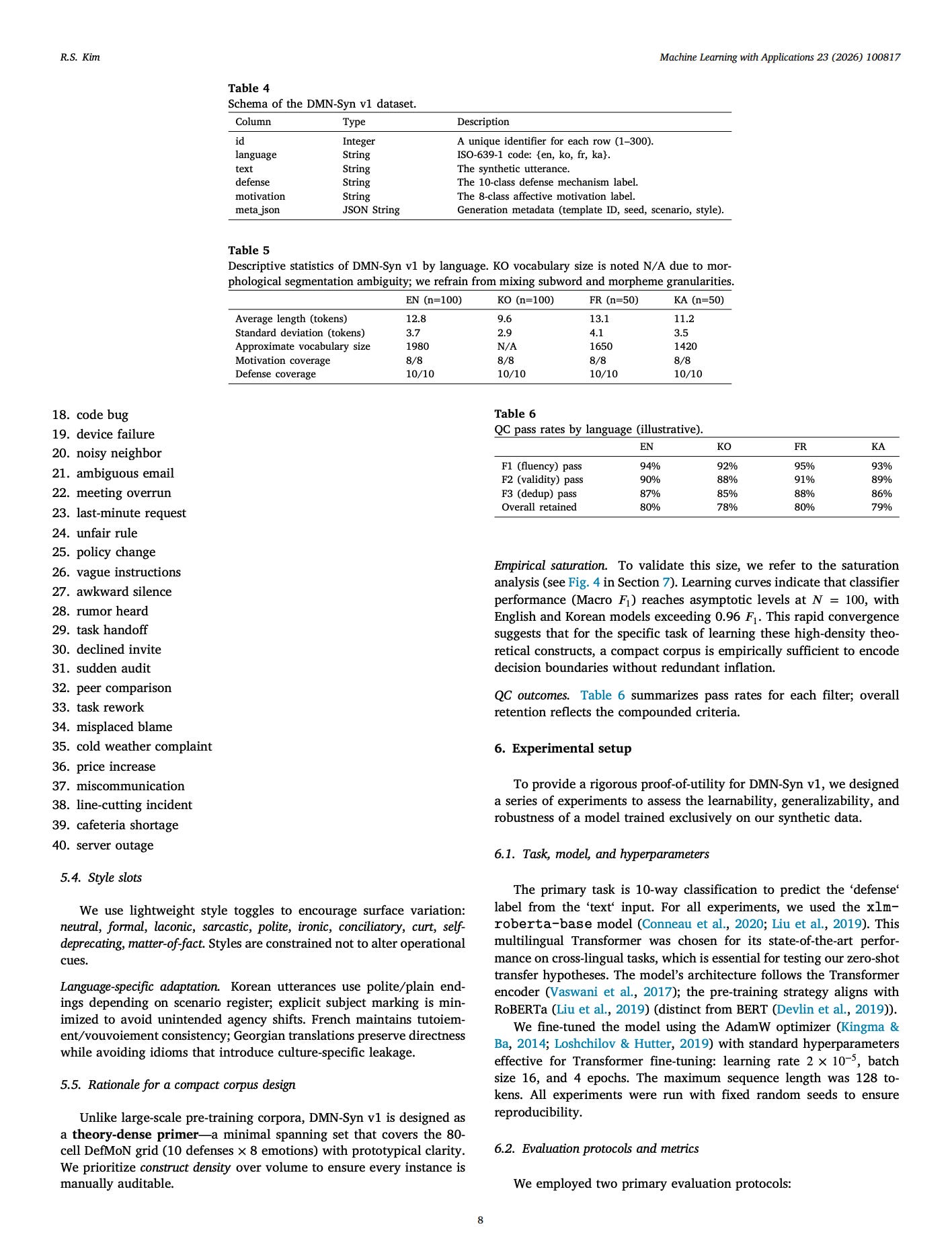
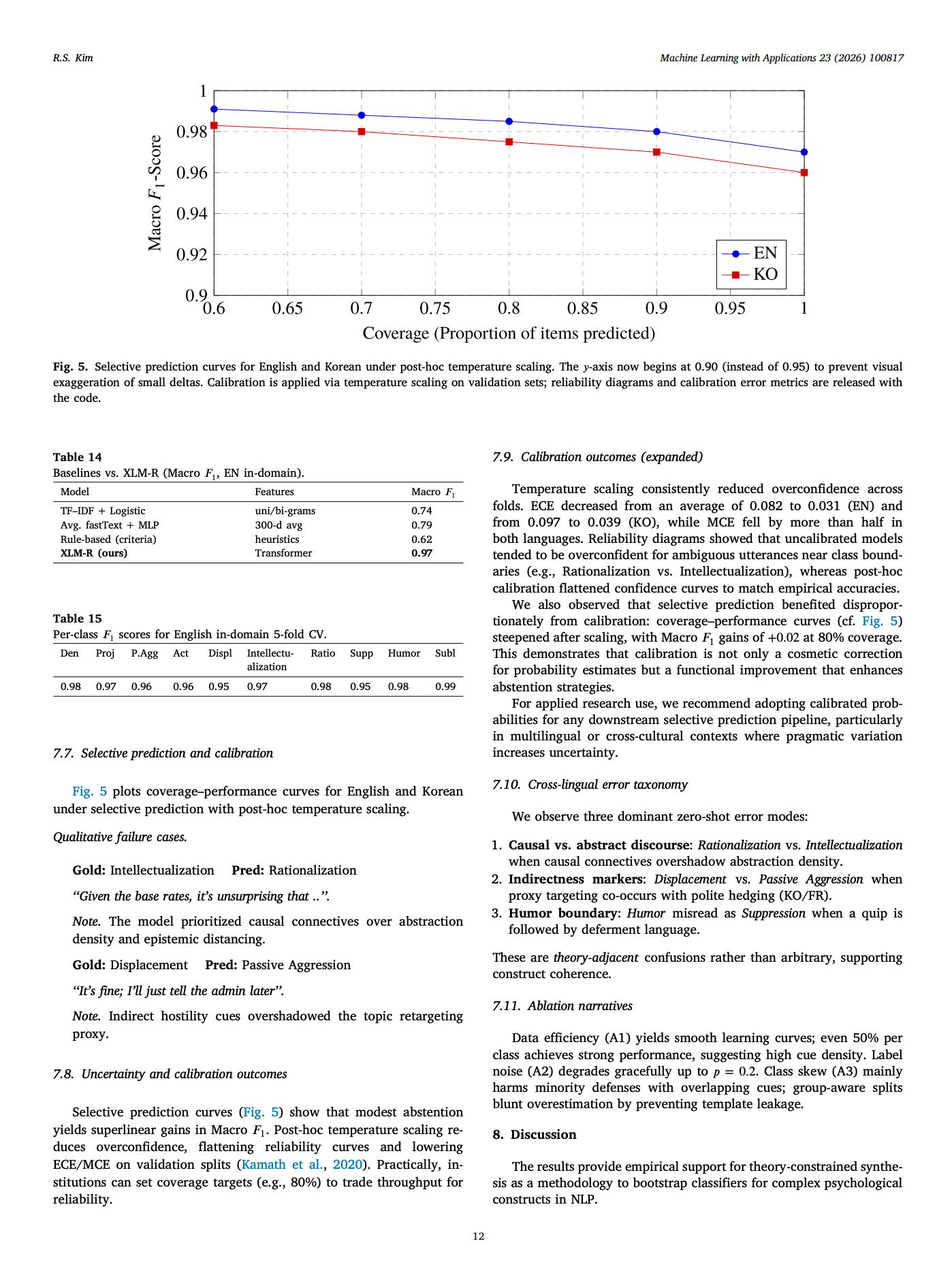
Within this framework, synthetic data functions as an analytic instrument. It allows specific mechanisms—normally entangled in naturalistic corpora—to be isolated, varied, and examined without conflating them with incidental noise or social convention.
This work was published in Elsevier’s Machine Learning with Applications.
The paper does not present a solution to emotion AI. It does not claim psychological completeness, nor does it propose alignment or safety as automatic outcomes of better modeling. Its contribution is more limited and more precise.
It establishes a condition.
Before emotional behavior can be modeled, evaluated, or governed, the assumptions that generate it must be made explicit. Without this step, performance improvements remain disconnected from interpretability, and robustness remains accidental.
DefMoN is therefore not an endpoint. It is infrastructure.
It precedes subsequent work on emotional self-modeling (PESAM) and on the quantification of interpretative failure (AAB). Those directions depend on a prior clarification of how emotion-like behavior is structurally produced in artificial systems.
There are limits to this approach. Theory-grounded construction necessarily inherits the constraints of the theory itself. If the theory is wrong, the data will reflect that error with equal fidelity. DefMoN does not eliminate this risk. It exposes it.
That exposure is intentional.
If an emotion AI system cannot account for the assumptions embedded in its data,
there is little reason to trust the interpretations it produces.
https://www.sciencedirect.com/science/article/pii/S2666827025002002?via%3Dihub
감정 AI는 어디서 실제로 무너지는가
정확도가 아니라 가정의 문제
감정 AI의 실패는 데이터가 부족해서 발생한 것이 아닙니다.
문제의 핵심은 감정에 대한 가정이 명시되지 않았다는 점에 있습니다.
지난 십여 년간 감정 컴퓨팅 분야는 꾸준한 성능 향상을 이루어 왔습니다. 감정 레이블링의 정확도는 높아졌고, 데이터셋은 확대되었으며, 평가 절차 또한 점점 정교해졌습니다. 그럼에도 불구하고 일반화의 취약성, 설명되지 않는 실패, 그리고 재현성의 불안정성은 반복적으로 관찰되고 있습니다.
이는 개별 모델의 결함이라기보다 구조적인 문제로 이해하는 편이 타당합니다.
대부분의 Emotion AI 시스템은 감정을 자명한 대상으로 전제합니다. 별도의 이론적 정당화 없이 분류와 비교가 가능한 것으로 가정하는 경우가 많습니다. 그러나 실제 인간의 감정 표현은 그러한 단순한 전제를 따르지 않습니다.
인간의 감정은 조절됩니다.
숨겨지기도 하고, 완화되거나 과장되며, 지연되거나 서사적으로 재구성되기도 합니다. 다시 말해 감정 표현은 원초적 신호가 아니라 방어, 자기 보호, 회피, 통제와 같은 동기적 압력의 결과로 나타납니다.
그러나 다수의 데이터셋은 이러한 조절의 층위를 충분히 반영하지 못하고 있습니다.
DefMoN은 바로 이 결여에서 출발합니다.
DefMoN(Defensive Motivational Nodes)은 하나의 데이터셋이 아니며, 범용적인 합성 데이터 생성기를 지향하지도 않습니다. 이는 감정 표현이 기저의 동기 구조로부터 어떻게 생성되는지를 명시적으로 구성하기 위한 데이터 프레임워크입니다. 이 접근에서 중요한 것은 데이터의 양이 아니라, 해당 감정 표현이 왜 그러한 형태로 나타나는지를 설명할 수 있는지 여부입니다.
이 프레임워크에서 합성 데이터는 분석적 도구로 기능합니다. 자연 데이터에 복합적으로 얽혀 있는 심리적 메커니즘을 사회적 규범이나 우연적 잡음과 분리하여 관찰할 수 있도록 합니다.
이 연구는 Elsevier의 Machine Learning with Applications에 게재되었습니다.
본 논문은 감정 AI 전반을 해결하려는 시도를 담고 있지는 않습니다. 심리적 완결성을 주장하지도 않으며, 정렬이나 안전을 자동적으로 보장한다고 말하지도 않습니다. 이 연구의 기여는 보다 제한적이면서도 명확합니다.
하나의 조건을 설정하는 데에 있습니다.
감정적 행위를 모델링하고 평가하기에 앞서, 그 행위를 생성하는 가정이 먼저 명시되어야 한다는 조건입니다. 이 단계가 선행되지 않는 한, 성능 향상은 해석 가능성과 연결되기 어렵고, 시스템의 견고함 또한 우연에 의존하게 됩니다.
이러한 의미에서 DefMoN은 하나의 종착점이 아니라 인프라에 가깝습니다.
이후에 제시되는 감정적 자기 모델(PESAM)이나 해석 붕괴의 계량(AAB) 또한, 감정적 행위가 인공 시스템 내에서 어떠한 구조를 통해 생성되는지를 밝히는 이 선행 단계 위에서만 성립할 수 있습니다.
물론 이 접근에는 한계도 존재합니다. 이론에 기반한 데이터 구성은 해당 이론의 제약을 그대로 계승할 수밖에 없습니다. 만약 이론이 부정확하다면, 데이터 역시 그 오류를 충실히 반영하게 될 것입니다. DefMoN은 이러한 위험을 제거하지는 않지만, 의도적으로 가시화합니다.
그 선택은 우연이 아닙니다.
감정 AI가 자신이 사용하는 데이터에 내재된 가정을 설명할 수 없다면,
그 시스템이 제시하는 감정 해석을 신뢰하기는 어렵습니다.
https://www.sciencedirect.com/science/article/pii/S2666827025002002?via%3Dihub